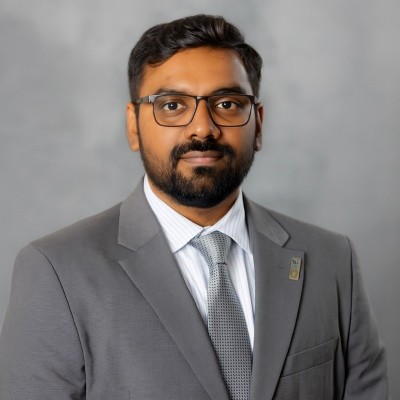
Vishwambhara Kumbharathi // Project Controls Senior Manager, Amtrak
Being part of the transportation industry allows me to contribute to infrastructure that people rely on every day while also helping advance the standards, tools, and practices used to deliver these programs more effectively.
Vishwa Kumbharathi, PMP, PSP, CEP is a Senior Manager, Project Controls at Amtrak, where he supports project controls, estimating, and cost management for rail and infrastructure programs. With experience across transportation, heavy civil, energy, and public infrastructure projects, he brings a data-driven approach to project delivery, cost estimating, planning, risk management, and governance. Vishwa holds a master’s degree in Construction Engineering and Management from Clemson University and a bachelor’s degree in Civil Engineering from Osmania University. He began his career in India with Larsen & Toubro before moving to the United States, where he has continued to build his career in cost engineering and project controls. An active member of AACE International, Vishwa serves as Chair of the AACE International Education Board and Vice President of the AACE New Jersey Section. He is also a member of the Clemson Young Alumni Council and has been involved in university outreach, mentorship, and professional development initiatives to introduce students and early-career professionals to project controls careers. Vishwa has presented at industry conferences on topics including strategic cost management, AI in estimating, supply chain disruption impacts, and ontology-based cost databases for rail infrastructure. He was recognized as an AACE International Outstanding Rising Professional and as an ACEC New Jersey Emerging Leader. He is passionate about advancing transportation project delivery through better project controls practices, digital transformation, and stronger professional standards in cost engineering.
Why transportation?
Transportation has always appealed to me because it directly affects how people live, work, and connect with opportunity. Roads, bridges, rail, transit, and passenger rail systems are not just construction projects; they are public assets that support mobility, economic growth, safety, and quality of life.
My interest in transportation grew through my work on rail and infrastructure programs, where I saw how strong project controls can influence better decision-making, funding stewardship, and project delivery. Transportation projects are complex, high-impact, and often delivered in active public environments, which makes cost estimating, scheduling, risk management, and governance especially important.
For me, transportation is the right field because it combines technical complexity with public purpose. I enjoy working on projects where the outcome is visible, long-lasting, and meaningful to communities. Being part of the transportation industry allows me to contribute to infrastructure that people rely on every day while also helping advance the standards, tools, and practices used to deliver these programs more effectively.
What’s your favorite way to get around the YPT-NYC region?
The Subway.
If you could snap your fingers and make one change to regional transportation, what would it be?
I would make regional transportation more seamless by improving last-mile connections between rail, transit, and local mobility options. Better last-mile connectivity would make the system easier to use, more reliable, and more accessible for everyday riders.
What advice would you give to your younger self?
Stay curious, be patient with your journey, and do not be afraid to ask questions. Every person who comes into your life will either teach you something or learn from you.
Do you have a favorite transportation book, blog, newsletter, podcast, or YouTube channel?
Railway Age is one of my go-to industry publications because it provides useful insights on rail trends, infrastructure developments, and issues shaping the transportation sector.
What is your favorite transportation-related fun fact or joke?
The NYCT subway has more stations than any other subway system in the world.

