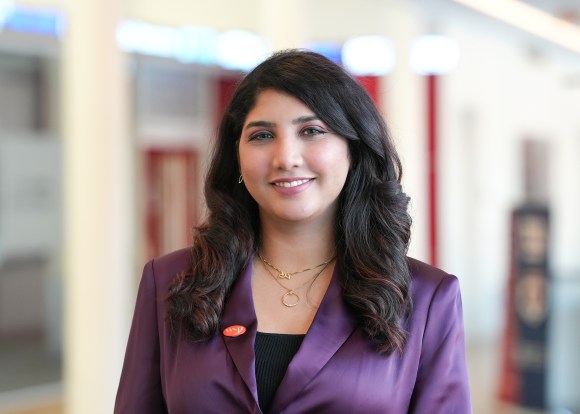
Karam Choudhary // Assistant Traffic Engineer at WSP Global
Every challenge taught me something valuable: resilience, adaptability, and the importance of staying curious.
Karam is a Traffic Engineer at WSP USA, where she applies her skills and knowledge in intelligent transportation systems, project planning, and civil engineering to various projects involving signing and striping, traffic and pavement studies, modeling and signal design for clients such as NJDOT, NJTA, and Port Authority. She has a Master of Science in Computer Science/Information Systems from Rider University. She also has a Masters in Construction Engineering Management and Bachelors in Civil Engineering from NED University in Pakistan. She is passionate about integrating information technology and artificial intelligence in the construction transportation industry and project management, which led her to pursue a PhD in Artificial Intelligence. Her research and thesis is based on “Artificial Intelligence for Intelligent Transportation Systems: Modeling, Optimization, and Real-Time Decision Making in Urban Mobility.”
Why transportation?
I chose transportation as a career because it’s the backbone of society, it connects people, communities, economies, and opportunities. Growing up in Karachi, which is Pakistan’s largest city and economic hub, is often characterized by severe traffic congestion, unregulated urban sprawl, and inadequate public transportation infrastructure. I witnessed firsthand how inefficient and chaotic traffic systems could limit access to education, healthcare, and jobs. That experience planted the seed for my interest in civil and traffic engineering. Over time, I realized that transportation is more than just roads and vehicles; it’s about movement, equity, safety, and sustainability. A single improvement in a transportation system can reduce commute times, lower emissions, save lives, and even boost a region’s economy. That kind of impact inspired me to dedicate my career to this field.
What’s your favorite way to get around the YPT-NYC region?
Honestly, my favorite way to get around the NYC region is a mix of the subway and Citi Bike. The subway is incredibly efficient when you’re trying to get across boroughs; nothing beats hopping on an express train and skipping traffic altogether. But for shorter trips or when the weather’s nice, I love using a Citi Bike. There’s something energizing about riding through the city streets, especially along the waterfront or down a protected bike lane. It gives you a totally different perspective of the city, more exciting, more connected.
If you could snap your fingers and make one change to regional transportation, what would it be?
I would create a fully integrated, AI-powered transit system that’s seamless, affordable, and equitable across all modes — trains, buses, bikes, ferries, and ride-shares.
Imagine opening a single app that not only plans your trip across all systems in real time, but also adjusts for delays, finds you the quickest or greenest route, and lets you pay with just one tap no matter if you’re switching from a subway to a ferry or hopping on a bike. And behind the scenes, AI would optimize traffic signals, reroute buses based on congestion, and ensure underserved neighborhoods get the same quality of service as Midtown Manhattan.
Who inspires you?
One person who truly inspires me is Dr. Mir Shabber Ali, a data scientist and transportation systems researcher who’s been at the forefront of integrating big data and intelligent systems into real-world traffic management. What inspires me about his is how he bridges the gap between engineering and actionable insight transforming raw sensor data into tools that improve people’s daily commutes. His worked on projects that monitor freeway performance, enhance transit reliability, and create smarter, more resilient transportation systems. His work reminds me that technology, when applied thoughtfully, can directly impact public safety, sustainability, and equity. More broadly, I’m inspired by all professionals engineers, planners, data scientists who take on complex urban challenges and use AI and innovation to make our cities more humane, efficient, and just.
What advice would you give to your younger self?
“Trust your journey even if the detours are part of the destination.”
There were times I doubted my path, especially when things didn’t go as planned whether it was navigating through academic pressure, switching focus areas, or starting over in a new country. But every challenge taught me something valuable: resilience, adaptability, and the importance of staying curious.
I’d also tell myself to start exploring emerging technologies earlier, especially how AI and data can shape fields like transportation. And most importantly: Speak up, ask questions, and never underestimate the power of showing up even when you feel underqualified. Growth doesn’t come from knowing it all; it comes from being willing to learn.
What are you working on currently that you’re most excited about?
Right now, I’m most excited about my research and work at the intersection of Artificial Intelligence and transportation engineering. I’m currently exploring how AI-driven tools like computer vision, deep learning, and predictive modeling can be applied to improve traffic flow, enhance safety, and optimize infrastructure planning in congested urban areas like New York and beyond.
One project I’m especially passionate about involves using real-time data from sensors, LiDar, VMX 2HA Mobile Scanning System and CCTV to predict congestion patterns and inform adaptive signal control systems. The goal is to not only reduce travel time, but also design smarter, more sustainable transportation networks that are responsive to real-world conditions.
Do you have a favorite transportation book, blog, newsletter, podcast, or YouTube channel?
- “The High Cost of Free Parking” by Donald Shoup
- CityLab (by Bloomberg)
- YouTube Channel Not Just Bikes
- Artificial Intelligence in Transportation: Information Technology Applications in Surface Transportation by National Research Council / TRB
 YPT-NYC